How it works
AI designs your ERP.
Bike’s kernel runs it.
Bike forms an ERP that fits your company in minutes, for under $5 of AI, and then runs it every day without AI. Here is the engineering that makes that work.
- No AIYour words and documentsA sentence, or your write-up, policies and an export
- AIAI writes a planIn Bike’s building blocks, by name
- No AIThe kernel checks itEvery sheet, column, step and person
- No AIAn app, versionedLive when you click, never before
- No AIThe kernel runs itForms, steps, rules, every day
AI is used where judgment helps: turning how you work into a design. Everything after the check is Bike’s own code.
An app is a file, not code
Each area of your company (hiring, spend, contracts) is an app: a small file in a fixed schema that Bike’s kernel knows how to run. Because it is data, not code, it can be checked before it’s live, versioned, and changed in plain words.
How an app is formed
Five steps, from your words to a working part of your ERP, usually in about a minute.
- ReadBike reads your documents as data. A line that tries to give it orders is flagged in the Audit log, never followed.
- PlanThe AI writes the app in Bike’s building blocks, by name, with its rules as plain sentences. It never writes code and never touches your data.
- CheckThe kernel checks every sheet, column, step and person against what exists. Anything invented is refused: the AI gets one try to fix it, or Bike says it couldn’t.
- PreviewYou read the plan in plain words, see what it does to today’s rows, and see each rule replayed on your last 90 days before it’s saved.
- ApplyOne click applies it all in one go, as a new version with an Audit log entry. A change that moves data you already have (a typed customer becoming a link to Customers) shows every row it moves and every row it can’t first; if any can’t, nothing moves, and the old values are kept.
A whole company at once
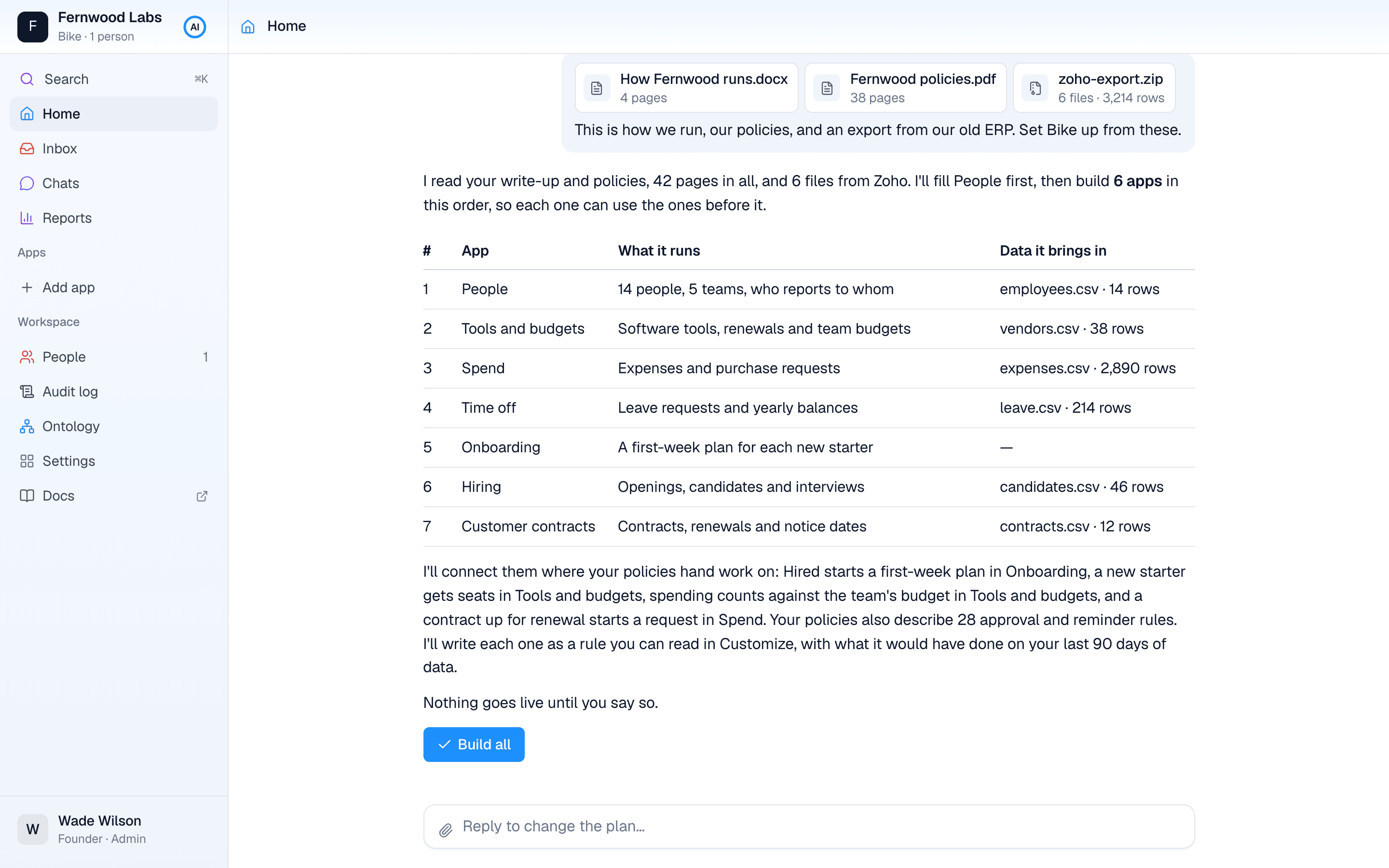
Upload your write-up, policies and an export, and Bike plans every app in order, so each can use the ones before it, with the data each brings in. It asks one question when your data and your policies disagree, and builds them all when you click Build all.
Why it fits any business
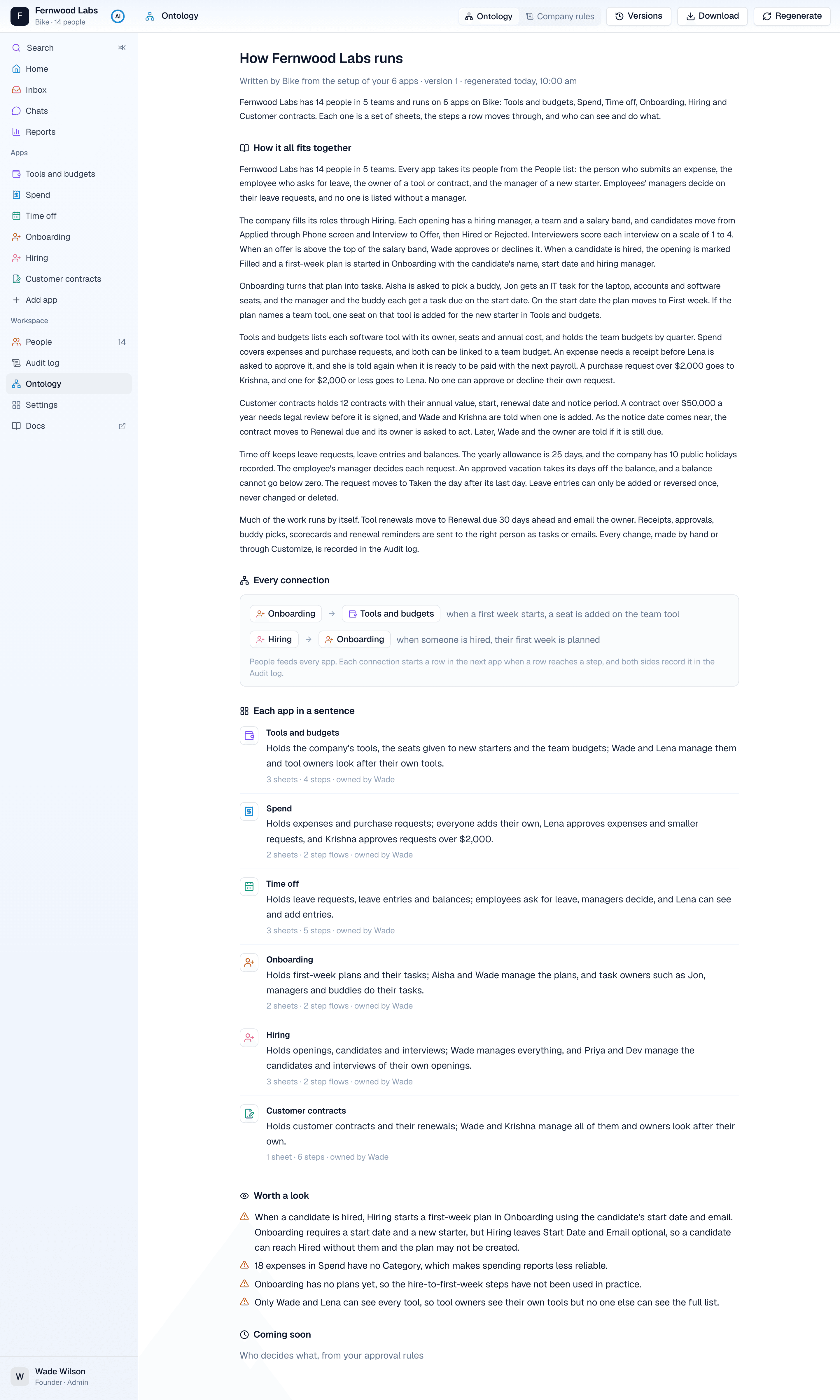
Every company is made of the same few things: records, the steps they go through, who may do what, and what should happen next. Bike’s building blocks combine into any process, and connections join apps so work passes between them:
- When a candidate is hired, their first week is planned in Onboarding.
- A bill is matched to its purchase order and what arrived before it can be paid.
- A time-off request checks the person’s balance and waits on their manager.
- A contract’s renewal starts a purchase request for the budget owner.
No custom code for any company. The Ontology page reads it all back to you, so you can judge: is this how we run?
Why it costs under $5
It sees the shape, not your rows
The AI gets how your apps are set up. Of your data it sees only what a task needs: 20 sample rows to map a file, a report’s result table, or the one row a suggestion is about.
It writes once; the kernel runs for free
An app is written once. Every form, step, rule, reminder and report after that runs in Bike’s own engine, at no AI cost.
Small jobs, small model
Mapping a file’s columns, wording a report’s sentence and suggesting a value use a small, cheap model; only planning uses the large one.
Mistakes are caught before they cost
The kernel’s checks catch a wrong answer at once, so a plan is fixed in one short retry, not rebuilt.
Why you can trust what it runs
The kernel is the only writer
Screens, imports, rules and AI plans all go through it, in one transaction: checked, applied, rules run, recorded.
Same input, same result
Rules run the same way every time, never by a model deciding on the day. A rule that would loop is refused when it’s saved.
Two locks on your data
Bike checks access on every read and write, and the database itself keeps each company apart and the logs append-only.
Nothing live until you click
No plan, change or AI suggestion reaches your data until a person confirms it, and every change is in the Audit log.
Request access
Bike is opening to a few companies at a time. Tell us your company, how many people work there, and what you run on today.